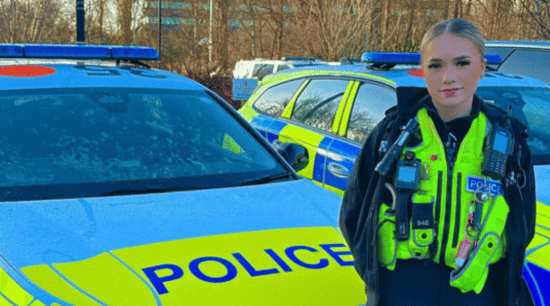
Police Constable Degree Apprenticeship
What is the PCDA?
The Police Constable Degree Apprenticeship (PCDA) is a great opportunity for anyone wishing to achieve a degree in recognition of their police training. It doesn’t matter if you have already studied for a different degree. All study is fully integrated into your workplace training and you do not attend a university campus. You will receive protected learning time, and there is no expectation that officers will have to use their own time to complete the degree. You will achieve a BSc (Hons) Professional Policing Practice upon successful completion, and this is fully funded by Cambridgeshire Constabulary whilst you earn a full salary throughout your training.
The PCDA is a three-year course with a three-year probation. Across years two and three, student officers will spend a total of about eight weeks completing their degree. This time will be split into smaller segments at various points across the second and third year. Most of years two and three are spent working as a police officer. The course culminates with officers reflecting on their journey to produce a professional development strategy. There is no dissertation
A modern degree-based education is no longer purely academic, there is now a strong emphasis on the development and application of professional practice in the workplace which this route provides.
The tuition fees for the degree will be covered by the force. You will also receive a salary of £29,907 upon joining, increasing to £31,164 after your first 12 months. Essentially you will earn while you learn and by the end of your probationary period you would have achieved a degree whilst also being paid a competitive salary.
More information
The PCDA is delivered entirely within working hours. Training takes place either on police premises or online, and there is no requirement to travel to university.
Training commences with a 22-week classroom-based phase of learning. The training is Monday to Friday during this period, and student officers are taught the fundamental knowledge, skills and behaviours that are required to be a police officer. This will also include personal safety training, first aid and there are several ICT systems that need to be understood. Student officers will also participate in a ‘practice’ investigation that begins with an arrest and goes through all the key steps of an investigation through to an appearance in court. During this period, there is also one week’s annual leave in the middle and again at the end.
The learning for year one culminates with an attachment to an operational Professional Development Unit. Student officers are now able to carry out the role of police officer whilst being tutored by an experienced colleague. Over this period, student officers are assessed for their readiness to be deemed safe and legal to police independently, and progress to being awarded Independent Patrol Status.
Year 2 and 3 of the PCDA are predominantly spent working towards full occupational competency in an active Police role. Across Years 2 and 3, student officers will spend a total of approximately 8 weeks completing their degree. This time will be split in to smaller segments at various points across the second and third year. The course culminates in the achievement of full occupational competency and the design of a professional development strategy. There is no dissertation.
- Be at least 18 years old
- Be a British Citizen, an EC/EEA national, Commonwealth citizen or foreign national with no restrictions on your stay in the United Kingdom
- Hold a full manual driving licence
The PCDA requires you to have:
GSCEs English and Maths grade C or 4 and above, or Level 2 functional skills English and Maths.
And
A minimum of 32 Ucas Points * from a level 3, or equivalent, qualification and two A-Level passes at Grade E or above.
Or
Applicants with less than 32 UCAS points will be considered if they can provide evidence of at least one year’s employment in a role with comparable skills to policing or academic study in the fields below. These applicants will be invited to a study skills review meeting, where an assessment will be made on their ability to meet the academic demands of the Police Constable Degree Apprenticeship. Applicants who pass the suitability discussion criteria will have met the university entry requirements.
Vulnerability/caring for others/working with communities:
- Nursing / Care Sector
- Social Work
- Youth Work
- Charity Work
- Teaching
Justice and law enforcement:
- Police staff – particularly custody, public contact/demand hub/enquiry office roles, investigative roles,
- Criminal justice sector/CPS/courts
- Border force
- Prison service
Relevant local authority experience which has involved close and sustained working with police:
- Integrated offender management
- Emergency planning
- Community safety
Emergency services – ambulance, fire
- Cyber/digital and financial fraud/crimes
- Specialist roles in banking and financial sector
- Digital Investigations
Meet our Officers
The role of a police officer is critical in maintaining public safety and order and you will handle things most people never experience in their lives. Find out first hand accounts of what the role of a student police officer in Cambridgeshire is like, what to expect and how to join.