Close announcement bar
Alert
Notice
We’re aware of an issue affecting the address finder on some forms. This is linked to a problem with an external service, which may mean you’re unable to complete your report or application at the moment. We’re monitoring the situation closely and will provide updates as soon as possible. Please try again later. We apologise for any inconvenience.

PCSO John Carter
John Carter became one of the country’s first ever PCSOs in August 2002 when the role was introduced as a pilot scheme in Westminster.
The father-of-two had previously been a security officer for Fulham Football Club and the manager of a travel bookstore in London.
He moved to work in Cambridgeshire three years later.
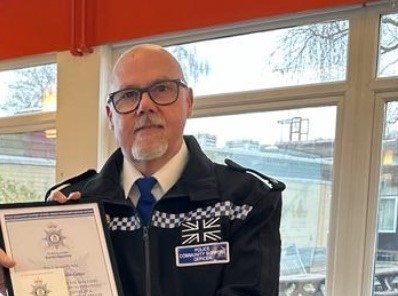
“It was never a career aspiration to join the police, but after leaving Fulham FC the role of PCSO was being introduced and I believed I had all the skills they were looking for in the new role.
“I have worked in Cambridge for more than 11 years - in two spells – and more than seven years in Huntingdon, a short time in St Neots.
“I have been school liaison officer in Huntingdon and was part of the community cohesion unit. I have been involved in multiple operations, from drugs factories to child sexual exploitation, attend cycle marking events, and I recently qualified as a Level 3 Community Safety Officer.
“I have gained a reputation for being able to identify outstanding suspects, and I have submitted more identification statements than almost anyone else in the force.
“I have been involved in some high-profile incidents - on scene preservation – and I have been heavily involved with difficult-to-reach communities.
“Every day is challenging as you do not know what you are going to encounter. Helping and supporting people in crisis, although problematic, is extremely rewarding when you can get them the help they desperately need.
“You will face regular negative comments from those that want to challenge your credibility. But it strengthens your resolve, that you did not rise to their misbehaviours.
“When working with the schools I have been a mentor to some children who appear to be straying from the safe path, so it is very rewarding to do early intervention and steer them away from criminality.
“Knowing that I am there to make a difference is important to me. I can often be the first person someone in crisis turns to. Or I can be the side of policing where those that have already strayed into criminality turn to or will confide in, and that is where your communication skills are key.
“It may not appear from the outside to be the most glamorous side of policing, but you have the flexibility to build strong relationships with key community contacts. The diverse range of jobs you encounter is like no other job. And unlike being a police officer you are given the chance to really get to know your communities.
“I have had a wonderfully varied career. It has had its challenges, but it has been an exciting career choice. And if you only use it as a stepping stone towards becoming a police officer, being part of the police family is tremendously worthwhile.”
Interested in becoming a PCSO?
We’re offering applications for Police Community Support Officers (PCSOs).
If you wish to find out more information about the role or wish apply to start your career as a PCSO, complete the online application form.