Spiking in the spotlight as students return
Main article content
Cambridgeshire Constabulary has launched its annual anti-spiking campaign, this year placing a spotlight on alcohol-based spiking – a form of the crime that is often underestimated and overlooked.
Running from 15 to 21 September, as part of National Anti-Spiking Intensification Week, the campaign coincides with the return of university students and aims to make nightlife safer for everyone.
Officers will be out across Cambridge and Peterborough city centres on both high-visibility and plain-clothed patrols. They’ll be working closely with licensed venues, universities, and local authorities to raise awareness, challenge suspicious behaviour, and tackle spiking head-on.
This year’s campaign challenges many of the myths surrounding spiking, in particular that spiking only involves so-called “date rape drugs”. In reality, alcohol is one of the most frequently used substances to spike someone and can be just as dangerous.
Spiking includes:
- Adding alcohol to a non-alcoholic drink without someone knowing
- Giving someone more alcohol than they agreed to, such as pouring a double instead of a single
- Topping up a drink without consent, especially when someone is already intoxicated
Inspector Ed McNeill said: “Spiking is an incredibly serious offence, and alcohol-based spiking is no exception. It’s often dismissed or even seen as a joke, but it can leave victims confused, vulnerable and traumatised.
“If someone gives you a double when you asked for a single, that’s spiking. It’s about consent and removing that consent is a crime.
“We want people to know that if they’ve been spiked – whether with alcohol, drugs or both – it’s not their fault. We’re here to help, not to judge.
“This campaign is about confronting perpetrators and making it clear that spiking has consequences. It has no place in Cambridgeshire.”
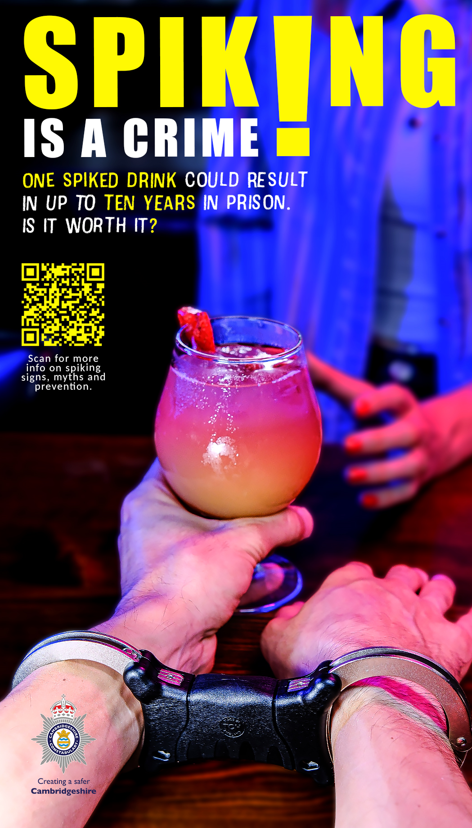
Digital boards will be displayed at both Cambridge universities during Freshers’ Week, delivering a clear message to potential offenders: spiking is illegal and can land you in prison for up to ten years.
The force is working in partnership with Anglia Ruskin University, Peterborough City Council and Peterborough Positive to target messages and improve safety measures.
DrinkSafe covers will be available at venues across Peterborough thanks to funding secured by the city council, offering an extra layer of protection for customers and helping to prevent drink tampering.
Dr Raj Lakshman, Director of Public Health, Peterborough City Council, said: “We are fully committed to working with our partners, including the police, to help raise awareness of drink spiking as part of our ongoing work to keep our communities safe.
“Whilst the chances of being spiked are low, we would urge people to always remain vigilant when on nights out or at social events. If you start to feel strange or more drunk than you thought you should be, it is vitally important to seek help straight away. If you feel seriously unwell, call 999 or ask someone to get you emergency medical assistance.”
Pep Cipriano, Chief Operating Officer, Peterborough Positive, said: “The safety of our city centre residents and visitors to our licensed venues is one of our top priorities. As part of our daily in-person engagements with our business community, we’re able to distribute DrinkSafe covers to venues and to retailers who can hand them to their employees. This campaign is a great example of partnership working that directly benefits our residents.”
You can find more information on spiking on our website, including advice on how to report incidents, and guidance on where to get medical help and emotional support. We also have a newly created page offering myth-busting information.